Picture of Joseph Smith Reading the Bible
Kent P. Jackson, "Joseph Smith's Biblical Antiquity," in Approaching Artifact: Joseph Smith and the Ancient World, edited past Lincoln H. Blumell, Matthew J. Grey, and Andrew H. Hedges (Provo, UT: Religious Studies Center; Salt Lake Urban center: Deseret Book, 2015), 165–93.
Kent P. Jackson was a professor of aboriginal scripture at Brigham Young University when this was written.
Virtually of Joseph Smith's career every bit Mormonism'south founding prophet was related in some way to the Bible. The simplest caption for this is that the Bible contains the record of God's dealings with people anciently, and Joseph Smith saw his career every bit the renewal and continuation of that work in modernistic times. For him, the key term that described his work was restoration, a word that he and his followers adopted to identify early Mormonism in general. Mormonism would be the restoration—the restoration of truth that God had revealed since the beginning of homo history, the restoration of the ancient potency to speak anew in God's proper name, and the restoration of God's aboriginal church building to correspond his will on earth. Joseph Smith said, "It is necessary in the ushering in of the impunity of the fulness of times; which dispensation is now beginning to usher in, that a whole, and complete, and perfect marriage, and welding together of dispensations, and keys, and powers, and glories should take place, and be revealed, from the days of Adam even to the nowadays fourth dimension."[1] It would be, in the words of a favorite Mormon quote from the New Testament, the "restitution of all things, which God hath spoken by the mouth of all his holy prophets since the world began."[ii] And all of it would center on the Bible as the revealed precursor and predecessor. Joseph Smith and his ministry would be the next affiliate of biblical events.
Much of Joseph Smith's exposure to the aboriginal world came through his contact with the Bible. Just his human relationship with it was dissimilar that of others of his generation. Information technology was interactive, not static, and information technology was not at all one-directional. I have argued elsewhere that for Joseph Smith, a cardinal upshot of his view toward the Bible was say-so: the biblical text was not an ultimate source of authority but a means to a greater source—the dominance of revelation which he believed he received from God.[three]
All early Latter-twenty-four hour period Saints were converts from other Christian persuasions, and most had been deeply religious before they embraced the Mormon message. They oft establish in Mormonism familiar teachings most the bones Christian principles that they had held dear in their previous denominations. These would include a literal reading of the stories in the Bible and a belief in the saving work of Jesus Christ with faith, repentance, redemption from sin, and eternal life. Yet beyond such fundamentals, much of Joseph Smith'southward pedagogy seemed strangely disconnected from the Christianity of his fourth dimension and identify, and he himself seemed not to care much about what other Christians believed. Moreover, although at least some early Latter-day Saints knew of the popular Bible commentaries of the 24-hour interval—manufactures in Mormon periodicals make reference to them[4]—Joseph Smith's biblical interpretations seem to testify no influence from the common views expressed in them. Nonetheless he maintained, maybe paradoxically, "Nosotros believe nix, merely what is to exist found in this volume." Indeed, "in information technology the 'Mormon' organized religion is to be found." [v] Needless to say, the religious teachers and commentators of his day did not concur with him.
Biblical Visions
The first events of the Restoration had obvious biblical connections.[6] Joseph Smith described his earliest dramatic run into with the Divine equally a theophany of God and Jesus when he was fourteen years old. The First Vision, as Latter-day Saints call the issue, put to the test words he read in the Bible about obtaining enlightenment through prayer: "Ask and yous shall receive[,] knock and it shall exist opened[,] seek and you shall find." And "If any of you lack wisdom, permit him enquire of God, . . . and it shall be given him."[vii] He wrote regarding the latter passage, "Never did any passage of scripture come with more than ability to the middle of man than this did at this time to mine," and then "at length I came to the conclusion that I must either remain in darkness and confusion, or else I must exercise equally James directs, that is, ask of God." The biblical passages provided the conduit to a new biblical consequence—Joseph Smith'due south come across with the God and Jesus of the Bible.
But for Joseph Smith, the Outset Vision was also a lesson in epistemology. Ancient texts would exist important for him throughout his career, but the source of his knowledge would exist revelation. Even before he went into the grove of trees on his father's subcontract to pray, he had already come up to the decision that the Bible could not exist his only source for religious knowledge, because, as he later wrote, "the teachers of religion of the unlike sects understood the same passages of scripture and then differently every bit to destroy all conviction in settling the question by an appeal to the Bible." Just after the Commencement Vision, he was able to say, "I accept learned for myself."[eight] This distinction would always remain of import for him; his prophetic career would not be an appeal to the Bible just an appeal for, and to, his own gift of revelation. That a large portion of his revelations dealt with topics that had biblical roots makes his independence from the biblical text all the more than meaning.
Joseph Smith described his next revelatory events every bit a serial of visits from an angel named Moroni, who made known to him the existence of the Book of Mormon. Those encounters accept many biblical connections, not the least of which is the book itself, which soon would exist known as the "Gold Bible." He reported that the affections told him, "God had a work for me to do." That work would include the translation of the Book of Mormon, but in that location would be much more than. The long encounters with the affections were teaching sessions in which the young Prophet was trained for his life's work, receiving "instruction and intelligence . . . respecting what the Lord was going to do and how and in what fashion his kingdom was to be conducted in the concluding days." Joseph Smith said that the angel taught him by quoting passage later on passage from the Bible and offering "many explanations" regarding them.[ix] In his master history, he placed his focus on five scriptures that Moroni quoted and discussed, but he stated that the angel too "quoted many other passages."[10] His associate Oliver Cowdery published three paper articles in which he identified thirty passages that Moroni quoted or discussed. [11] From them and from Moroni's commentary regarding them, young Joseph Smith would gain one of his fundamental beliefs about scripture: much of the message of the prophets since ancient times was aimed toward the work of restoration to which God had called him.
Many of the Bible passages quoted by Moroni, co-ordinate to the accounts of Oliver Cowdery and Joseph Smith, have become staple Mormon texts. The topics of those passages, and the interpretation given them by Latter-twenty-four hour period Saints, have become foundational to the Mormon message. The following summary places them in the context in which Latter-day Saints empathize them.
Scattering and restoration. The theme of apostasy and restoration is a bedrock of Mormonism. God destroyed and scattered ancient Israel because of wickedness, and the world continues in sin: "This people describe near me with their oral cavity, and with their lips exercise honour me." But they "have removed their middle far from me, and their fearfulness toward me is taught by the precept of men."[12] It was these conditions that set the stage for the calling of Joseph Smith: "God hath chosen the foolish things of the world to confound the wise, . . . the weak things of the globe to confound the things which are mighty."[13] A subsequently revelation identifies Joseph Smith equally the "rod out of the stem of Jesse" of whom Isaiah prophesied, "a servant in the easily of Christ."[14] He would be one of God'due south messengers to prepare the way for Jesus' return.[fifteen]
New revelation. In bringing virtually the Restoration, God would cause the "wisdom" of the world to perish and the "understanding of their prudent men" to be subconscious.[sixteen] He would pour out his spirit on all flesh, empowering all to enjoy divine spiritual gifts.[17] One of the great revelations would be the Book of Mormon, "a marvellous work and a wonder" foretold by the prophet Isaiah.[18]
Restoring divine power. Latter-mean solar day Saints encounter their temple worship suggested in Isaiah's prophecy that in the last days, "the mountain of the Lord'due south firm" would be established.[xix] The last two verses of the Old Testament (Malachi four:5–6) play a primal role in Latter-day Saint theology, foretelling the coming of Elijah to seal the hearts of parents and posterity. They see the fulfillment of the prophecy in Elijah'southward appearing to Joseph Smith in 1836, restoring the power to demark in heaven what is bound on world and making possible the work of Latter-day Saint temples.[20]
Gathering scattered Israel. Moroni quoted passages nigh Israel'south return to promised lands. From its dispersed and scattered condition, Israel in the last days would respond to the vox of God'southward servants, "the watchmen upon the mount Ephraim," who would say, "Arise ye, and allow the states go upwardly to Zion, unto the holy Mount of the Lord our God."[21] God would transport out "fishers" and "hunters" to find his covenant people in the places of their scattering throughout the earth. They would be gathered "from the east, and from the due west, from the northward, and from the southward."[22] The "outcasts of Israel" and the "dispersed of Judah" would set bated their enmity and get one. Even those non of the house of Israel would join past covenant. Gentiles, State of israel, and Judah would come up together "from the 4 corners of the earth."[23]
End-time destruction of the world. Joseph Smith wrote that Moroni quoted Malachi as follows: "For behold, the 24-hour interval cometh that shall fire as an oven, and all the proud, yea, and all that do wickedly shall burn as stubble," leaving them "neither root nor co-operative."[24] This process of God'due south judgment would exist the "bully and dreadful twenty-four hours of the Lord." It would purify "similar a refiner's fire, and similar fullers' lather." God's judgments would be accompanied by "wonders in the heavens and in the earth. . . . The lord's day shall be turned into darkness, and the moon into blood."[25]
The Second Coming of Jesus and his millennial reign. Moroni quoted, "The Lord, whom ye seek, shall suddenly come to his temple," and "the Lord shall reign for e'er, even thy God, O Zion, unto all generations."[26] Latter-day Saints follow Joseph Smith'south lead in identifying Jesus as the Coming One in Erstwhile Testament prophecies who will usher in a millennium of peace. "With righteousness shall he guess the poor, and reprove with disinterestedness for the meek of the earth. . . . And righteousness shall be the girdle of his loins, and faithfulness the girdle of his reins."[27] In that day, people volition "beat their swords into plowshares, and their spears into pruninghooks: nation shall non lift up sword against nation, neither shall they acquire war whatsoever more than." "The wolf also shall dwell with the lamb, and the leopard shall lie down with the kid; and the calf and the immature panthera leo and the fatling together; and a little child shall lead them."[28]
One of the remarkable features of these scriptures is that all only two of those listed by Oliver Cowdery and Joseph Smith come from the Former Testament. Contemporary writers favored the New Attestation, and early Mormons cited the New Testament almost twice as oftentimes as they cited the Old Testament.[29] But Moroni's message had its focus on end-time events, and the eschatological prophecies of Isaiah and Jeremiah, from which more than half of the passages come, fit the theme perfectly.
Mormonism's primary interpretation of these verses is found in the context in which they were received—the angel's instructions to Joseph Smith regarding his mission and the form of the Restoration to the end of fourth dimension. The passages, and the interpretations Joseph Smith and his followers placed on them, are vintage Mormonism.[30] The setting in which they became part of the message places them among the founding texts of Joseph Smith's biblical restoration. Some other Christians in his solar day used some of these scriptures with similar interpretations.[31] Simply these are the exceptions, every bit well-nigh of the verses are interpreted in Mormon sources very differently from in non-Mormon sources.
Historian Philip Barlow has pointed out that Joseph Smith and his followers read about of the Bible literally.[32] In reading scripture literally they were not alone, but the distinctiveness of their literalism was that they believed that the prophecies of the Bible were fulfilled in Mormonism itself. Consider the belief in the literal building of a latter-twenty-four hour period temple—a "mountain of the Lord'southward house" in Isaiah'due south prophecy—in dissimilarity to its estimation as a metaphor for the Christian Church building (among other things) in standard commentaries.[33] Perhaps the literal interpretation is less intriguing than the idea that it would be Latter-day Saints who would exist edifice the prophesied temple in the last days. Writers from the eighteenth and nineteenth centuries often assigned to the days of Jesus and the Apostles the fulfillment of scriptures that Mormonism sets in the context of the latter-day Restoration. Notable examples are Joel 2:28–29 and Malachi 4:5–half-dozen, in which Latter-day Saints see the restoration of spiritual gifts and powers to Joseph Smith and the church building he founded.[34] And Mormonism'south expansive view of the restoration of Israel goes well beyond what most commentators envisioned, again pointing to Mormonism as the fulfillment.[35] In all, the nontraditional meanings that Latter-day Saints give to these verses, their juxtaposition to the narrative of the Restoration, and the belief that they foretell the piece of work initiated by Joseph Smith make both their private interpretations and their collective message uniquely Mormon.
Joseph Smith recounted that the early on days of the Restoration also included visits from well-known Bible characters who came to give him authority—John the Baptist and the Apostles Peter, James, and John. The Baptist, Joseph Smith announced, restored the priesthood of ancient Israel, which he inherited through the lineage of his antecedent Aaron. The three Apostles restored a higher priesthood, chosen the Melchizedek Priesthood, and the apostolic powers they received from Jesus Christ. Thus, in Joseph Smith's restoration of biblical artifact, the gifts and powers of both the Sometime and the New Testaments would be realized again in the last days.
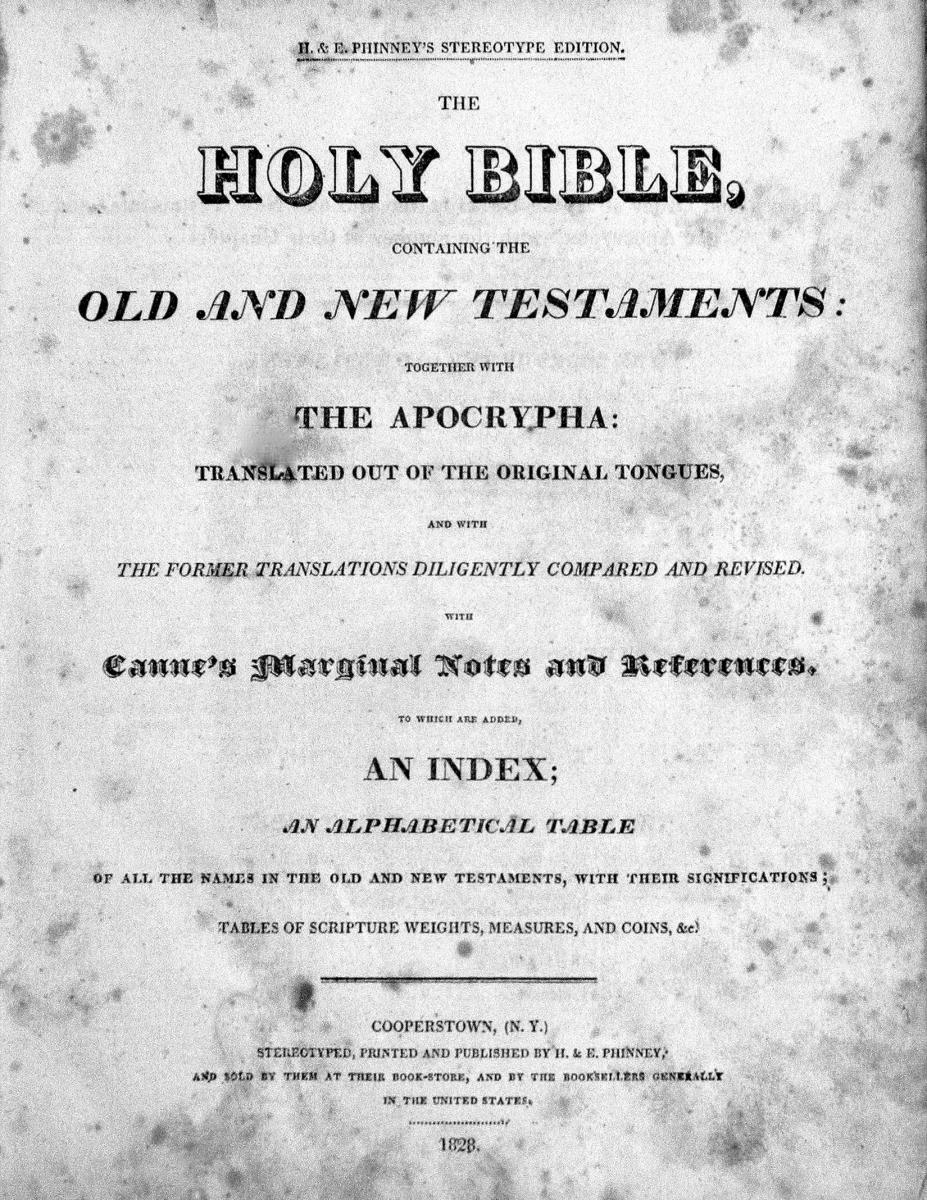 Title page, H. & E. Phinney Male monarch James Bible, 1828; aforementioned edition that Joseph's Smith used for New Translation of the Bible.
Biblical Revelation
Over the course of Joseph Smith's life, he recorded well over a hundred texts that early Latter-day Saints received as revelations—the expression of God'south discussion to his Church. Nearly of them were published in his lifetime, some originally in Mormon newspapers. Since 1835 they have been nerveless in a volume chosen the Doctrine and Covenants. Several of Joseph Smith's other narratives and translations are in a collection chosen the Pearl of Great Price (outset published in 1851). Both of these volumes are notwithstanding in impress and are function of the Latter-mean solar day Saint canon.
We usually practice not recollect of Joseph Smith's revelations as biblical texts, merely in many ways they are. Scholars accept pointed out how the language of the revelations abounds in King James vocabulary and phraseology.[36] Merely beyond that, the revelations are closely tied to the Bible because and so much of their content deals with themes from the Old and New Testaments. This is deliberate because the idea of the Restoration presupposes that Christianity would be on the earth before the days of Joseph Smith, and the Bible would be the means by which it would be preserved and spread. What was to exist restored in the latter days would be the gospel'southward fullness, not its already-present general principles and behavior. Amongst the topics of the revelations in the Doctrine and Covenants are God and Jesus, the Holy Ghost, faith, repentance, baptism, justice, mercy, resurrection, spiritual gifts, the last days, the Second Coming of Jesus, and a grand years of millennial peace. All of these are easily recognized as biblical concepts and were familiar to Joseph Smith'due south followers from their prior clan with other Christian denominations. None were introduced for the first fourth dimension in the new revelations, yet the revelations add together significant new interpretations to each of them. In some cases, Latter-solar day Saints empathize the topics in much the same manner that other Christians practice. But in many instances, the revelations add ideas that go well beyond what is plant in the Bible and thus depart radically from Christian tradition.
Some of the revelations bargain explicitly with passages, people, and events from the Old and New Testaments. One, for example, contains a new account of the Olivet Discourse from Matthew 24 and some other, an explanation of the parable of the wheat and the tares from Matthew xiii.[37] A revelation fleshes out an account recorded in John 21, and others provide explanations for passages in 1 Corinthians.[38] Joseph Smith's doctrine of dissimilar degrees of heaven in the afterlife springs from a passage in John v.[39] Biblical priesthood is discussed, as are the lives of Adam, Enoch, Moses, and other luminaries from the Quondam Testament.[40] Even the organization of the Church building comes from revelations relating to the Bible, with the Twelve, the Lxx,[41] and "the same organization that existed in the primitive church."[42] And the Prophet said that his ideas for governing councils came to him in a vision of Peter administering the church in aboriginal times.[43]
One wide example—the idea of the temple—will illustrate the extent to which the Prophet's revelations expand and, in some cases, radically redefine biblical concepts. In the Quondam and New Testaments, the temple is central to Israel'southward formal worship system. It was the merely canonical setting for State of israel'south most sacred rites, and information technology was the location to which all Israelite men were to assemble three times each year.
Joseph Smith's biblical Restoration would require the restoration of sacred buildings like these. "What was the object of Gathering the Jews together or the people of God in any age of the world [?], the main object was to build unto the Lord an house whereby he could reveal unto his people the ordinances of his house and glories of his kingdom & teach the peopl[e] the ways of salvation. . . . It is for the same purpose that God gathers togethe[r] the people in the terminal days to build unto the Lord an house to prepare them for the ordinances & endowment washings & anointings &c."[44] Joseph Smith's ideas regarding the temple were non clear all at once but came to him in stages. The first references to building a firm of God came in a revelation of 1831 without mention of what its purpose would be.[45] When instructions were received later to build a temple in the Church'southward cardinal location of Kirtland, Ohio, the revelation chosen it "a house of prayer, a house of fasting, a house of religion, a house of learning, a firm of glory, a house of order, a business firm of God." A after revelation said it would be "for your sacrament offering, and for your preaching, and your fasting, and your praying, and the offering up of your nigh holy desires," and "for the school of mine apostles."[46] One week afterward the building's dedication, Joseph Smith recorded in his journal that as he and Oliver Cowdery were praying in it, Jesus appeared to them, saying, "I have accepted this business firm and my name shall be here; and I volition manifest myself to my people, in mercy, in this House." And then Moses, Elias, and Elijah appeared to the two men and invested them with heavenly powers that they had possessed in biblical times.[47]
The function of Joseph Smith's temple would not exist at all like that of the temples of aboriginal Israel, with brute sacrifices and incense offerings. Its principal use would be equally a meetinghouse for regular worship services, merely with additional use as an administrative headquarters and a school. However above all else, the temple was understood to exist a place of revelation.
The Prophet recorded in his periodical early in 1836 that he learned in a temple vision that "all who take died without a cognition of this gospel, who would have received it, if they had been permit[t]-ed to tarry, shall be heirs of the angelic kingdom of God."[48] In 1838 he stated: "All those who have non had an opportunity of hearing the gospel, and being administered to by an inspired human being in the flesh, must have it hereafter, earlier they can exist finally judged." [49] These statements represent the beginnings of what Latter-day Saints phone call the "redemption of the dead"—the doctrine that individuals in the globe of departed spirits tin can encompass the gospel there and that people on world can vicariously administer saving rites to them in the temple. For Joseph Smith, this was a biblical doctrine. He quoted from Paul to argue that it continued a practise from New Testament times: "Else what shall they do which are baptized for the dead, if the dead ascension not at all? why are they so baptized for the dead?"[50]
In 1842 Joseph Smith introduced what he called the endowment, a temple ritual involving a sequence of covenants and blessings. He afterwards put in writing a revelation on the eternity of temple marriages. In it nosotros read that marriages performed under the authority of the restored priesthood will be valid not merely on earth but in the eternal world besides.[51] Afterward the temple in Nauvoo, Illinois, was completed, information technology would be the location where eternal marriages would be performed.
It would exist impossible to argue that Joseph Smith's thought of the temple—or the associated ideas of redeeming the expressionless and eternal marriages—grew naturally out of the biblical text. Yet he believed that these were necessary parts of the biblical Restoration. Nor did his temple ideas result naturally from his environment. Christians from the first century onward viewed the temple as something belonging to the one-time covenant of Moses. Nearly commentators saw no need for such a building in the Christian age.[52] It has been argued that some of the formal aspects of Joseph Smith'south temple rituals were borrowed from Masonry, which too used the word temple for the buildings in which its ceremonies took place.[53] And there may take been other Christian churches that used the word temple in the names of their buildings. Notwithstanding none of these examples tin can exist shown to be true models for Joseph Smith'due south temple concept, which expanded unrecognizably across any possible antecedents. As such, Joseph Smith's vision of temples in the last days remains unique to him.
Biblical Translation
Peradventure as much of Joseph Smith'southward exposure to the ancient world came through the biblical texts he produced, specially through his revision of the Bible, as through any other source. He began his ambitious editing of the Bible in June 1830 and completed it nearly 3 years afterwards. He went through the Bible from cover to cover, although not quite in that order, and dictated 446 pages of revisions to his scribes. In the process, he produced new interpretations of biblical passages, people, and events and inserted new text that Mormons believe may include material that had been lost during the Bible'south transmission. [54] The Prophet fabricated changes, additions, and corrections in over three thousand verses. Many were small-scale rewordings of King James language to make the text more clear and understandable for modern readers. Just in some parts of the Bible, much new material was added, such as in the Genesis chapters that are included in the Pearl of Great Toll. Joseph Smith and his contemporaries referred to the revision as the "New Translation." [55]
From working on his Bible revision, Joseph Smith concluded much virtually the ancient earth, merely very little of what he concluded would be recognizable to other Christians. None of the details of his New Translation are equally important as the one central principle that came to underlie much of his biblical didactics throughout his life: the fulness of the gospel of Jesus Christ was revealed in the beginning of human history and e'er was the only ways of human salvation. This is made known in dramatic ways in the New Translation, starting with an business relationship of the revelation of Christianity to Adam and Eve: "And in that twenty-four hour period, the Holy Ghost barbarous upon Adam, which beareth record of the Father & the Son Saying I am the only begotten of the male parent from the begining hence forth & forever; that as thou hast fallen, yard mayest be redeemed, & all flesh, even every bit many as will." God said further to Adam, "If thou wilt turn unto me, & hearken unto my vox & believe, & repent of all thy transgressions, & be baptized, fifty-fifty in water, in the name of mine only begotten Son, who is full of grace & truth; who is Jesus Christ; the only proper name which shall be given under Sky, whereby salvation shall come unto the children of men, [and then] ye shall receive the gift of the holy Ghost."[56]
The New Translation tells united states of america that Adam and Eve's descendants were Christians. Noah, for instance, taught, "Believe & repent of your sins & be baptized in the name of Jesus Christ the son of God fifty-fifty as our fathers did & ye shall receive the Holy Ghost."[57] Remarkable passages like these from Joseph Smith's reading of the Bible provided a perspective on the ancient globe that was far outside over 2 yard years of biblical tradition.
An editorial in the Church'due south newspaper The Evening and Morning Star expressed the Prophet's view on the gospel's antiquity: "Perhaps, our friends will say, that the gospel and its ordinances were non known till the days of John the son of Zecharias, in the days of Herod the king of Judea. Merely we will here look at this point: For our own part, we cannot believe, that the ancients in all ages were so ignorant of the arrangement of heaven equally many suppose, since all that were ever saved, were saved through the power of this great plan of redemption, as much so before the coming of Christ as since." For Joseph Smith, this was one of the basic principles of the man experience. If it were otherwise, "God has had different plans in operation, (if we may and then express it,) to bring men back to dwell with himself; and this nosotros cannot believe, since there has been no change in the constitution of man since he fell." "The gospel," we are told, "was preached to Abraham. We would like to be informed in what name the gospel was so preached, whether information technology was in the name of Christ or another proper name? If in whatsoever other name, was it the gospel?"
The Volume of Mormon, published earlier the beginning of Joseph Smith's work on the Bible, depicts ancient worshipers of Jesus offering sacrifices in anticipation of Jesus' earthly coming. Joseph Smith did not view this as incongruous simply in harmony with the real purpose of the sacrifices, which "served, as we said before, to open their optics, and enabled them to await forward to the time of the coming of the Savior, and to rejoice in his redemption." In doing so, they learned to "rely upon him alone as the author of their conservancy."[58]
These ideas become well beyond simply reading the Onetime Testament through Christian (or Mormon) lenses. Joseph Smith was rewriting history here, the primeval history of the man family, and putting Jesus at its centre from the very beginning. The thought that the Christian gospel was revealed to Adam and Eve—making it the starting time religion in human history—was nigh unique in his generation.[59] Yet it is a thread that runs non merely through the scriptures he brought forth but likewise through his interpretation of the Old and New Testaments. Animate being sacrifice, as we read in the New Translation, was "a similitude of the Cede of the just begotten of the Father, which is full of grace & truth." The sacrifices undertaken by Abraham and other Saints in antiquity were not, like those of their contemporaries, to provide food for their hungry gods simply to look to the time to come time in which the true God, Jesus Christ, would sacrifice himself for the blessing of all humankind. Thus Abraham "looked forth and saw the days of the Son of man, & was glad."[60]
In Joseph Smith's view of biblical antiquity, at that place was a fundamental difference between the worship of believers before the fourth dimension of Moses and Israel's religion thereafter. His conventionalities in a Christian context for the stories in Genesis rewrites that book in a dramatic way, merely his understanding of the law of Moses and its origin rewrites the rest of the Bible. The New Translation tells us that equally a result of Israel's rebellion that culminated in the golden calf incident, God took from Israel "the everlasting covenant of the holy Priesthood."[61] The highest say-so—the priesthood of Melchizedek—was withdrawn, and the police of Moses was instituted. God left "the lesser priesthood"—the priesthood of Aaron—"which the Lord in his wrath caused to continue with the house of Aaron among the children of Israel until John."[62] As we have seen, Joseph Smith reported that every bit part of the "restitution of all things," both of these priesthoods were restored to him for the benefit of God'south work in the latter days.
Joseph Smith as Bible Commentator
The first published Mormon Bible commentary was Oliver Cowdery's discussion of Zephaniah.[63] Joseph Smith did not follow adjust. He never wrote a commentary, nor did he bear witness any inclination to codify his interpretations in any mode outside of his revelations and translations. But throughout his career, he used Bible passages every bit illustrations and explanations in letters and editorials. In his sermons also, he commented on Bible passages ofttimes, and because many of those sermons were recorded past listeners, we have sources for much of his biblical thought. For the Nauvoo menstruation, the time in which he spoke in large public settings the nearly, we have primary records for over 170 of his discourses. In virtually of his doctrinal sermons, he quoted, paraphrased, or reasoned out of the Bible, eventually touching on hundreds of verses.[64] These Bible-based sermons became one of the principal means by which he communicated with the Saints. Still in them, every bit Barlow has pointed out, his objective was "rarely to translate and defer to the Bible for its own sake."[65] It was, instead, to unfold the ongoing development of his beliefs to the Church. Nor did he, in his sermons, "preach strictly from the Bible in Protestant manner."[66] Indeed, if what attracted early converts was the familiar voice of the Bible in the Mormon bulletin, what they heard in Joseph Smith's Nauvoo sermons was an expanded gospel that started from the familiar but projected beyond anything they had heard before.
In 1994 I published a book chosen Joseph Smith's Commentary on the Bible. For it, I collected out of primary sources all of the known commentary on biblical passages that Joseph Smith gave in his sermons and writings. I matter that characterizes those excerpts is how freely the commentary flowed from his consciousness, even if it might not seem to others to menses freely from the text. I know of no example in which he turned to a printed commentary to help him understand a biblical text. Some of his interpretations may not accept been unique, and some may accept agreed with the views of others. Simply those are exceptions. And further, none of that is to the indicate. Joseph Smith believed that he understood the Bible as information technology was meant to be understood, independent of whatsoever earthly source.
Two examples of commentary from his sermons will suffice to show the unique nature of the Prophet's interpretations. In commenting on the account of Jesus driving evil spirits out of a homo (or men) that afterwards possessed a herd of pigs, he stated: "The great principle of happiness consists in having a body. The Devil has no trunk, and herein is his penalty. He is pleased when he can obtain the tabernacle of [a] man and when cast out by the Savior he asked to become into the herd of swine showing that he would prefer a swine's torso to having none. All beings who have bodies take power over those who accept non. The devil has no power over united states only equally we permit him; the moment we defection at anything which comes from God[,] the Devil takes power."[67] Standard commentaries focused on the obvious features of the story.[68] Joseph Smith's, all the same, provides an underlying ontological framework toward understanding both Satan and humans.
The second case provides an explanation for a statement from Jesus in the Olivet Soapbox: "And this gospel of the kingdom shall be preached in all the world for a witness unto all nations; then shall the finish come up."[69] Joseph Smith interpreted the passage to foretell the revelation of the gospel to a witness, who would accept information technology to the world in the concluding days.
When it is rightly understood it will exist edifying. .. . The Savior said, when those tribulations should accept identify, it should be committed to a man, who should be a witness over the whole earth, the keys of knowledge, power, and revelations, should be revealed to a witness who should hold the testimony to the world; information technology has e'er been my province to dig upwards hidden mysteries, new things, for my hearers. . . . All the testimony is, that the Lord in the last days would commit the keys of the Priesthood to a witness over all people—has the Gospel of the Kingdom commenced in the last days? and will God take information technology from the man, until he takes him, himself? . . . John saw the angel having the holy Priesthood who should preach the everlasting gospel to all nations,[70]—God had an angel, a special messenger, ordained, & prepared for that purpose in the concluding days. . . . Every man who has a calling to minister to the Inhabitants of the globe, was ordained to that very purpose in the One thousand Council of Sky before this world was—I suppose that I was ordained to this very office in that grand Council. . . . God will e'er protect me until my mission is fulfilled.[71]
Not all commentaries current in Joseph Smith's day shared his belief that this prophecy was to exist fulfilled in an end-time setting.[72] And his understanding that he was its fulfillment was certainly unique to him.
But if Joseph Smith'south primary biblical hermeneutic was the antiquity of, and the universal need for, Christ's gospel, his secondary interpretive principle, as nosotros have already seen, was that his own prophetic mission continued that of the prophets of the past and that the work in which he was engaged was the very culmination of the efforts of all the prophets before him. He believed that his was "the dispensation of the fulness of times, when . . . all things shall be restored, as spoken of by all the holy prophets since the world began: for in it volition accept place the glorious fulfillment of the promises fabricated to the fathers." [73] Indeed, "the impunity of the fulness of times will bring to light the things that accept been revealed in all former dispensations, also other things that have non been earlier revealed." [74]
Joseph Smith's Biblical Modernity
Latter-day Saints read the Bible with a view of antiquity informed by Joseph Smith's revelations and his reading of the Bible. Together, those sources create a vision of the ancient earth and its history that contrasts dramatically with traditional Christian views. To Joseph Smith, however, his nontraditional interpretation came naturally from the text and was not something he imposed on it. "We teach nothing but what the Bible teaches," he said. [75] However again, for him the source of his interpretation was not the text itself but the revelation he received to guide him to understand information technology. He said, "God may correct the scripture by me if he choose,"[76] and, "I have the oldest Book in the world & the Holy Ghost[.] I thank God for the quondam Book just more for the Holy Ghost."[77]
Joseph Smith's revelations and translations mention or discuss—by proper name—virtually every important person in the Bible, forging a link from him and his followers back to their counterparts in the ancient world. In turn, he believed that the people in the Bible anticipated his time and the work he would do. "They take looked forward with joyful apprehension to the day in which we lived; and fired with heavenly and joyful anticipations they accept sung, and [written], and prophesied of this our twenty-four hour period; . . . nosotros are the favored people that God has fabricated choice of to bring about the Latter Day glory; information technology is left for us to see, participate in, and help to coil frontwards the Latter Twenty-four hours glory; 'the dispensation of the fulness of times, when God will get together together all things that are in heaven, and all things that are upon the earth, fifty-fifty in one.'" [78]
Latter-solar day Saints (myself included) are fond of quoting Alexander Campbell's complaint about the Volume of Mormon—it conveniently dealt with, and provided answers for, "every mistake and virtually every truth discussed in New York for the final ten years." [79] The same could take been said about Joseph Smith'southward revelations and his New Translation. Some modern observers, as well, take suggested conscious intent on his office to address bug in Christian theology and biblical estimation.[80] But the testify does not show intent of that sort. Some of the revelations he announced did come in respond to questions he had. But those questions were about always provoked past previous revelations and past the situations he and his followers faced attempting to comply with what they perceived as God's will. The revelations themselves rarely have themes merely usually skip from discipline to subject field, suggesting that Joseph Smith's ideas came to him spontaneously and unsystematically. The history of his well-documented life does not show him seeking to deal with the behavior of other faiths. In all, he seemed to exist equally surprised as his followers past the content of new communications from God.
This leads to the following question: Did Joseph Smith (who was an uneducated farmer) realize (at age twenty-iii when he produced the text of the Book of Mormon and at twenty-iv when he produced the new Genesis capacity) that his new scriptures were proposing solutions to issues that thoughtful Christians had struggled with for two millennia? If he, through the construct of his biblical artifact, was responding to the beliefs of other Christians, he seemed oddly unaware that he was doing so. Richard Bushman asks the follow-up question: "Did Joseph realize he was departing from traditional Christian theology? The record of his revelations and sermons gives no sense of him arguing confronting received beliefs. He does not refer to other thinkers as foils for his views. . . . His storytelling was oracular rather than argumentative. He made pronouncements on the potency of his ain inspiration, heedless of current opinion."[81] The sources support this analysis, suggesting that Joseph Smith was perhaps non fifty-fifty unaware of many of the theological issues with which other Christians were grappling—theological issues for which Latter-24-hour interval Saints detect answers in his teachings and translations. Thus whatsoever one might conclude about the ultimate source of his theological intuition and his unique views regarding the Bible and its world, it would be hard to argue that they are simply the product of the common Christian beliefs of his day.
Notes
---
[1]"Letter from Joseph Smith," Times and Seasons, Oct 1, 1842, 935 (D&C 128:18).
[2] Acts 3:21. Unless otherwise indicated, all Bible quotations are from the King James translation, the common Bible of early Latter-day Saints.
[iii] Kent P. Jackson, "Joseph Smith and the Bible," Scottish Periodical of Theology 63, no. 1 (2010): 24–40.
[iv] Adam Clarke, John Gill, and Thomas Scott are mentioned specifically. Encounter Evening and Morning Star, August 1832, 21; Messenger and Advocate, April 1835, 97; Times and Seasons, September ane, 1842, 907. Disdain for commentators is evidenced in Times and Seasons, November 15, 1840, 215; January 1, 1842, 645; August i, 1843, 285.
[v] Mathew Southward. Davis to Mary Davis, February 6, 1840, in Joseph Smith, History of the Church of Jesus Christ of Latter-twenty-four hour period Saints, ed. B. H. Roberts, 2nd ed. rev. (Table salt Lake City: Deseret Volume, 1978), 4:78.
[half-dozen] On the topic of the Bible and Joseph Smith, meet Gordon Irving, "The Mormons and the Bible in the 1830s," BYU Studies xiii, no. iv (1973): 473–88; Grant Underwood, "Joseph Smith'southward Use of the Quondam Testament," in The Old Testament and the Latter-24-hour interval Saints (Salt Lake Urban center: Randall Book, 1986), 381–413; Philip L. Barlow, Mormons and the Bible: The Place of the Latter-day Saints in American Religion, updated ed. (New York: Oxford University Press, 2013), chapters ane and 2; Kent P. Jackson, comp. and ed., Joseph Smith'due south Commentary on the Bible (Table salt Lake City: Deseret Book, 1994); Kent P. Jackson, ed., The King James Bible and the Restoration (Provo, UT: Religious Studies Center, 2011); Jackson, "The Male monarch James Bible in the Days of Joseph Smith," in The Rex James Bible and the Restoration, 138–61; Jackson, "The King James Bible and the Joseph Smith Translation," in The King James Bible and the Restoration, 197–214; Jackson, "Joseph Smith and the Bible," 24–40.
[7] Matthew 7:7 (paraphrased in Joseph Smith's 1835 account of the First Vision), Joseph Smith, 1835–1836 Journal, 23 (November ix–xi, 1835), in Dean C. Jessee, Mark Ashurst-McGee, and Richard Fifty. Jensen, eds., Journals, Book 1: 1832–1839, vol. 1 of the Journals series of The Joseph Smith Papers, ed. Dean C. Jessee, Ronald K. Esplin, and Richard Lyman Bushman (Salt Lake Metropolis: Church Historian's Press, 2008), 87; hereafter JSP, J1. James 1:v; Joseph Smith, "History of Joseph Smith," Times and Seasons, March fifteen, 1842, 727–28 (Joseph Smith–History one:11).
[8]"History of Joseph Smith," March 15, 1842, 728 (Joseph Smith–History 1:12–13, twenty).
[9]"History of Joseph Smith," April 15, 1842, 753 (Joseph Smith–History 1:33, 41); May two, 1842, 771 (Joseph Smith–History 1:54).
[10]"History of Joseph Smith," April xv, 1842, 753 (Joseph Smith–History 1:41).
[11] Cowdery'south articles are in the course of letters addressed to W. W. Phelps; "Letter of the alphabet Iv. To W. W. Phelps, Esq.," Messenger and Advocate, Feb 1835, 77–80; "Letter VI. To Due west. W. Phelps, Esq.," Messenger and Advocate, April 1835, 108–12; "Letter VII. To W. Due west. Phelps, Esq.," Messenger and Abet, July 1835, 156–59. The combined Bible passages are equally follows (those cited by Joseph Smith are in italics): Deuteronomy 32:23–24, 43; Psalms 100:1–2; 107:1–7; 144:xi–12, 13; 146:10; Isaiah i:7, 23–24, 25–26; 2:1–four; 4:v–6; 11:ane–sixteen; 29:11, 13, 14; 43:vi; Jeremiah 16:16; xxx:18–21; 31:i, 6, 8–9, 27–28, 31–33; 50:4–5; Joel 2:28–32; Malachi three:1–4 (?); 4:1–6; Acts 3:22–23; 1 Corinthians 1:27–29.
[12] Isaiah 29:13.
[thirteen] 1 Corinthians ane:27.
[fourteen] Isaiah 11:1; revelation, March, 1838 (D&C 113:four).
[15] Malachi iii:1.
[16] Isaiah 29:xiv.
[17] Joel 2:28–29.
[18] Isaiah 29:eleven, 14.
[19] Isaiah 2:one–4.
[20] See vision, Apr iii, 1836 (D&C 110:13–16). We have more than extant commentary from Joseph Smith on Malachi four:5–6 than on any other passage; see Jackson, Joseph Smith's Commentary on the Bible, 69–74.
[21] Jeremiah 31:vi, every bit worded in Oliver Cowdery'south business relationship. The King James translation does not include "the holy Mountain of." See Cowdery, "Letter of the alphabet VI," 111.
[22] Jeremiah xvi:sixteen; Psalm 107:three; cf. Isaiah 43:6; Jeremiah 31:8.
[23] Isaiah 11:12–13; cf. Jeremiah fifty:four.
[24]"History of Joseph Smith," Apr 15, 1842, 753 (Joseph Smith–History one:37); cf. Malachi 4:1.
[25] Joel 2:30–31.
[26] Malachi 3:1; Psalm 146:10.
[27] Isaiah 11:2, 4–five. Mormonism is incomparably premillennialist. Come across Grant Underwood, The Millenarian World of Early on Mormonism (Urbana and Chicago: Academy of Illinois Printing, 1993).
[28] Isaiah ii:4; 11:6.
[29] Irving, "The Mormons and the Bible in the 1830s," 478–lxxx.
[30] Irving finds many of the aforementioned themes emphasized in the writings of early Latter-day Saints; run into "The Mormons and the Bible in the 1830s," 480–83, 486–87.
[31] See Thomas Scott on Isaiah 2:2–5. He places the fulfillment "in the times of the Messiah," "which arbitrate between his coming and the end of the globe." Scott (1747–1821) was an Anglican priest who became an Evangelical. His commentary was printed in a variety of forms by unlike publishers. Run into, for example, The Holy Bible. Stereotyped Edition from the 5th London Edition (Boston: Samuel T. Armstrong, Crocker and Brewster; New York: J. Leavitt, 1827).
[32] Barlow sees a "selective literalism" amid Joseph Smith and the Latter-day Saints; run into Mormons and the Bible, 33–40, seventy–71.
[33] Isaiah two:4; see Matthew Henry'south commentary: "Christianity shall then exist the mount of the Lord'southward house; where that is professed God will grant his presence, receive his people'southward homage, and grant instruction and blessing, as he did of old in the temple of Mountain Zion." Henry (1662–1714) was a Presbyterian whose commentary was published in a multifariousness of means and sometimes in conjunction with Scott's. An American publication is An Exposition of the Old and New Testaments . . . with Practical Remarks and Observations by Matthew Henry (New York: John P. Haven; Pittsburgh: Robert Patterson; Philadelphia: Towar and Hogan, 1828). See also Matthew Poole on Isaiah ii:iv: "The temple of the Lord which is upon Mount Moriah; which yet is not to be understood literally of that textile temple, simply mystically of the church of God, as appears from the next following words, which will not acknowledge of a literal interpretation." Poole (1624–79) was a Presbyterian Nonconformist whose commentary, finished by colleagues after his death, went through several publishers. Encounter, for example, Annotations upon the Holy Bible, vol. ane (London: Thomas Parkhurst, Jonathan Robinson, Thomas Cockerill Sr., Bradbazon Ailmer, John Lawrence, and John Taylor, 1696); vol. 2 (London: Thomas Parkhurst, Dorman Newman, Jonathan Robinson, Brabazon Ailmer, and Thomas Cockerill, 1688).
[34] John Gill, for example, identifies Elijah in Malachi 4:5–half dozen: "Not the Tishbite, equally the Septuagint version wrongly inserts instead of prophet; not Elijah in person, who lived in the times of Ahab; but John the Baptist, who was to come in the power and spirit of Elijah." Gill (1697–1771) was a Baptist and a Calvinist. See An Exposition of the Former Attestation (Philadelphia: William W. Woodward, 1817–19).
[35] In contrast to what Latter-day Saints empathise as Ephraim initiating the gathering of Israel in the latter days (Jeremiah 31:half-dozen), see Poole: "The best interpreters judge that this prophecy was fulfilled under the gospel; for both Galilee and Samaria received the gospel, as appeareth from Acts viii. 1, 5, 9, xiv; ix. 31." See as well Scott, quoting Lowth: "The word may be applied to those evangelical preachers, who should be instruments in converting the Jews to Christ, and bringing them into the church building."
[36] Barlow, Mormons and the Bible, 21–26, 68; Ellis T. Rasmussen, "Textual Parallels to the Doctrine and Covenants and Volume of Commandments as Found in the Bible" (primary's thesis, Brigham Young Academy, 1951); Eric D. Huntsman, "The King James Bible and the Doctrine and Covenants," in Jackson, The King James Bible and the Restoration, 182–96.
[37] Revelation, March 7, 1831 (D&C 45); and revelation, December half dozen, 1832 (D&C 86).
[38] Revelation, April 1829 (D&C 7); revelation, March eight, 1831 (D&C 46); and revelation, 1830 (D&C 74).
[39] Revelation, Feb 16, 1832 (D&C 76).
[forty] Revelation, September 22–23, 1832 (D&C 84); and revelation, Apr 1835 (D&C 107).
[41] Revelation, March 28, 1835 (D&C 107:22–27).
[42] Joseph Smith, "Church History," March 1, 1842, 709.
[43] Minutes, February 17, 1834, 29–thirty, in Gerrit J. Dirkmaat, Brent M. Rogers, Grant Underwood, Robert J. Woodford, and William G. Hartley, eds. Documents, Volume 3: February 1833–March 1834, vol. 3 of the Documents series of The Joseph Smith Papers, ed. Ronald K. Esplin and Matthew J. Abound (Salt Lake City: Church Historians, Press, 2014), 437–38.
[44] Soapbox of June xi, 1843, recorded by Wilford Woodruff; in Andrew F. Ehat and Lyndon Westward. Cook, eds., The Words of Joseph Smith: The Contemporary Accounts of the Nauvoo Discourses of the Prophet Joseph (Provo, UT: Religious Studies Eye, 1980), 212–xiii.
[45] Run across revelation, July twenty, 1831 (D&C 57:3); and revelation, August 1, 1831 (D&C 58:57).
[46] Revelation, December 27–28, January iii, 1833 (D&C 88:119); and revelation, June 1, 1833 (D&C 95:16–17).
[47] Joseph Smith, 1835–36 Journal, 192 (April 3, 1836); JSP, J1:219 (D&C 110:iii, half-dozen–7, nine–10).
[48] Joseph Smith, 1835–36 Journal, 136–37 (January 21, 1836); JSP, J1:168 (D&C 137:seven).
[49] Elders' Journal, July 1838, 43.
[50] one Corinthians fifteen:29. Clarke calls this "the most hard verse in the New Testament." None of the major commentaries electric current in Joseph Smith'due south day interpreted this verse the way he did, but both Gill and Scott acknowledge that some others had done and so.
[51] Revelation, July 12, 1843 (D&C 132:fifteen–nineteen). Fifty-fifty the institution of polygamy, made known in the same revelation, was viewed as the restoration of a biblical practice.
[52] See Adam Clarke at Matthew 24:2. Clarke (1760–1832) was a Methodist whose massive commentary was a standard in Joseph Smith's time. See Adam Clarke, The Holy Bible, Containing the Old and New Testaments: The Text Printed from the Well-nigh Correct Copies of the Present Authorized Translation, Including the Marginal Readings and Parallel Texts, with a Commentary and Critical Notes (Baltimore: John J. Harrod, 1836).
[53] Meet the summary in Richard Lyman Bushman, Joseph Smith: Rough Stone Rolling (New York: Alfred A. Knopf, 2005), 449–52.
[54] For the New Translation, meet Scott H. Faulring, Kent P. Jackson, and Robert J. Matthews, eds., Joseph Smith'due south New Translation of the Bible—Original Manuscripts (Provo, UT: Religious Studies Center, 2004); Kent P. Jackson, The Volume of Moses and the Joseph Smith Translation Manuscripts (Provo, UT: Religious Studies Center, 2005); Scott H. Faulring and Kent P. Jackson, eds., Joseph Smith's Translation of the Bible: Electronic Library (Provo, UT: Brigham Young University Press, 2011); Kent P. Jackson, "Joseph Smith's Cooperstown Bible: The Historical Context of the Bible Used in the Joseph Smith Translation," BYU Studies 40, no. 1 (2001): 41–seventy; Kent P. Jackson and Peter M. Jasinski, "The Process of Inspired Translation: Two Passages Translated Twice in the Joseph Smith Translation of the Bible," BYU Studies 42, no. 2 (2003): 35–64; Kent P. Jackson and Charles Swift, "The Ages of the Patriarchs in the Joseph Smith Translation," in A Witness for the Restoration: Essays in Award of Robert J. Matthews, ed. Kent P. Jackson and Andrew C. Skinner (Provo, UT: Religious Studies Center, 2007), 1–eleven; Kent P. Jackson, "New Discoveries in the Joseph Smith Translation of the Bible," rev. ed., in By Study and by Religion: Selections from the Religious Educator, ed. Richard Neitzel Holzapfel and Kent P. Jackson (Provo, UT: Religious Studies Heart, 2009), 169–81; Kent P. Jackson, "Joseph Smith'south New Translation of the Bible," in Joseph Smith: The Prophet and Seer, ed. Richard Neitzel Holzapfel and Kent P. Jackson (Provo, UT: Religious Studies Center, 2010), 51–75.
[55] As also does a passage in the Doctrine and Covenants; see revelation, January 19, 1841 (D&C 124:89); Times and Seasons, July 1840, 140. Run across also Smith, History of the Church, ane:341, 365; four:164. Since the tardily 1970s, the revision has been called commonly the "Joseph Smith Translation" (JST). The title Inspired Version refers to the edited, printed edition, published in Independence, Missouri, past the Community of Christ.
[56] Onetime Testament Manuscript 2, page 10, lines 21–25 (Moses v:9); folio 17, lines 31–37 (Moses 6:52); Faulring, Jackson, and Matthews, Joseph Smith'south New Translation of the Bible, 603, 612.
[57] Old Testament Manuscript 2, page 27, lines 8–ten (Moses 8:24); Faulring, Jackson, and Matthews, Joseph Smith's New Translation of the Bible, 625.
[58]"The Elders of the Church in Kirtland, to their Brethren Abroad," Evening and Morning Star, March 1834, 287. This was presumably authored past Joseph Smith. At the least, it was certainly written under his management and expresses his views.
[59] Heikki Räisänen and Terryl L. Givens discuss others who desired or imagined Christianity earlier Christ and the theological problems that drove that desire; encounter Räisänen, "Joseph Smith as a Creative Interpreter of the Bible," Dialogue: A Journal of Mormon Thought 43, no. ii (summer 2010): 74–77; and Givens, "Joseph Smith: Prophecy, Process, and Plenitude," in Joseph Smith Jr.: Reappraisals after Two Centuries, ed. Reid L. Neilson and Terryl L. Givens (New York: Oxford University Printing, 2009), 114–15.
[threescore] Quondam Testament Manuscript ii, page 10, lines 21–25 (Moses five:7); page twoscore, lines 34–35; Faulring, Jackson, and Matthews, Joseph Smith's New Translation of the Bible, 603, 643.
[61] Old Testament Manuscript 2, folio 72, lines 34–35 (Deuteronomy x:2); Faulring, Jackson, and Matthews, Joseph Smith's New Translation of the Bible, 709.
[62] Revelation, September 22–23, 1832 (D&C 84:24–27).
[63] Oliver Cowdery, "The Prophecy of Zephaniah," Evening and Morning Star, February 1834, 132–33; March 1834, 140–42; Apr 1834, 148–49.
[64] See Kent P. Jackson, "The Prophet's Teachings in Nauvoo," in Joseph: Exploring the Life and Ministry of the Prophet, ed. Susan Easton Blackness and Andrew C. Skinner (Salt Lake Metropolis: Deseret Volume, 2005), 367–79. The sermons are compiled in Ehat and Cook, Words of Joseph Smith. The impressive scripture index in this collection (pages 421–25) illustrates the breadth of Joseph Smith's biblical didactics.
[65] Barlow, Mormons and the Bible, xxxii.
[66] Barlow, Mormons and the Bible, xxxiii.
[67] See Matthew 8:28–34; Marker 5:1–xiii; Luke 8:26–39; discourse of January 5, 1841, recorded by William Clayton; Ehat and Cook, Words of Joseph Smith, lx.
[68] See, for instance, Matthew Henry on Matthew 8:28–34; and John Gill on Marker 5:1–13.
[69] Matthew 24:14.
[seventy] See Revelation 14:6.
[71] Discourse of May 12, 1844, recorded by Thomas Bullock; Ehat and Melt, Words of Joseph Smith, 366–67.
[72] Clarke, Gill, and Scott identify the fulfillment in the first century, Henry sees a fulfillment in the first century and again at the finish of time, and Poole does non take a position.
[73] Joseph Smith, "To the Saints Scattered Away," Times and Seasons, October 1840, 178.
[74]"Minutes of a Conference of the Church of Jesus Christ of Latter Solar day Saints, held in Nauvoo, Ill, Commencing Oct. 1st, 1841," Times and Seasons, October 15, 1841, 578.
[75] Mathew S. Davis to Mary Davis, February six, 1840, in Smith, History of the Church, 4:78.
[76] Discourse of April 13, 1843, recorded by Willard Richards; Ehat and Melt, Words of Joseph Smith, 191.
[77] Discourse of April 7, 1844, recorded by Wilford Woodruff; Ehat and Cook, Words of Joseph Smith, 345.
[78]"The Temple," Times and Seasons, May ii, 1842, 776.
[79]"He [Joseph Smith] decides all the corking controversies;—babe baptism, ordination, the trinity, regeneration, repentance, justification, the fall of man, the atonement, transubstantiation, fasting, penance, church authorities, religious feel, the call to the ministry, the general resurrection, eternal penalization, who may baptize, and even the question of free masonry, republican regime, and the rights of human being." Alexander Campbell, "Delusions," Millennial Harbinger, February 7, 1831, 93.
[80] See, for example, Kathleen Flake, "Translating Fourth dimension: The Nature and Function of Joseph Smith'due south Narrative Canon," Journal of Organized religion 87, no. 4 (October 2007): 511–27; Heikki Räisänen, "Joseph Smith as a Artistic Interpreter of the Bible," 64–85.
[81] Richard Lyman Bushman, Joseph Smith: Crude Rock Rolling (New York: Alfred A Knopf, 2005), 457-58.
Source: https://rsc.byu.edu/approaching-antiquity-joseph-smith-ancient-world/joseph-smiths-biblical-antiquity
0 Response to "Picture of Joseph Smith Reading the Bible"
Post a Comment