How to Read Data From Com Port and Separate by Function Key in Java
This browser is no longer supported.
Upgrade to Microsoft Edge to accept reward of the latest features, security updates, and technical back up.
Azure Functions HTTP trigger
The HTTP trigger lets you invoke a function with an HTTP asking. You can use an HTTP trigger to build serverless APIs and respond to webhooks.
The default return value for an HTTP-triggered function is:
-
HTTP 204 No Contentwith an empty body in Functions ii.x and college -
HTTP 200 OKwith an empty trunk in Functions 1.x
To modify the HTTP response, configure an output binding.
For more data about HTTP bindings, run across the overview and output binding reference.
Case
- C#
- C# Script
- Java
- JavaScript
- PowerShell
- Python
The following case shows a C# function that looks for a proper name parameter either in the query cord or the body of the HTTP request. Notice that the return value is used for the output binding, only a render value aspect isn't required.
[FunctionName("HttpTriggerCSharp")] public static async Task<IActionResult> Run( [HttpTrigger(AuthorizationLevel.Function, "get", "post", Route = zip)] HttpRequest req, ILogger log) { log.LogInformation("C# HTTP trigger function processed a request."); string name = req.Query["proper name"]; string requestBody = String.Empty; using (StreamReader streamReader = new StreamReader(req.Body)) { requestBody = expect streamReader.ReadToEndAsync(); } dynamic information = JsonConvert.DeserializeObject(requestBody); proper noun = name ?? data?.name; return name != null ? (ActionResult)new OkObjectResult($"Hello, {name}") : new BadRequestObjectResult("Please pass a proper noun on the query string or in the request trunk"); } Attributes and annotations
In C# class libraries and Coffee, the HttpTrigger attribute is available to configure the function.
You can set the authorization level and allowable HTTP methods in attribute constructor parameters, webhook type, and a route template. For more information about these settings, see configuration.
- C#
- C# Script
- Java
- JavaScript
- PowerShell
- Python
This example demonstrates how to use the HttpTrigger attribute.
[FunctionName("HttpTriggerCSharp")] public static Job<IActionResult> Run( [HttpTrigger(AuthorizationLevel.Bearding)] HttpRequest req) { ... } For a complete case, see the trigger example.
Configuration
The following tabular array explains the binding configuration properties that you set in the function.json file and the HttpTrigger attribute.
| function.json property | Aspect belongings | Description |
|---|---|---|
| type | n/a | Required - must exist set up to httpTrigger. |
| direction | n/a | Required - must be set to in. |
| proper name | n/a | Required - the variable name used in function code for the request or asking torso. |
| authLevel | AuthLevel | Determines what keys, if any, need to be present on the request in lodge to invoke the role. The authorization level can exist one of the following values:
|
| methods | Methods | An array of the HTTP methods to which the office responds. If non specified, the part responds to all HTTP methods. Run into customize the HTTP endpoint. |
| route | Route | Defines the road template, controlling to which request URLs your function responds. The default value if none is provided is <functionname>. For more than information, see customize the HTTP endpoint. |
| webHookType | WebHookType | Supported only for the version 1.ten runtime. Configures the HTTP trigger to act as a webhook receiver for the specified provider. Don't set the
|
Payload
The trigger input blazon is alleged as either HttpRequest or a custom type. If you choose HttpRequest, you go full access to the asking object. For a custom type, the runtime tries to parse the JSON asking body to set the object properties.
Customize the HTTP endpoint
Past default when you create a function for an HTTP trigger, the function is addressable with a route of the course:
http://<APP_NAME>.azurewebsites.net/api/<FUNCTION_NAME> You can customize this route using the optional route belongings on the HTTP trigger's input bounden. As an instance, the following function.json file defines a route holding for an HTTP trigger:
{ "bindings": [ { "type": "httpTrigger", "proper noun": "req", "management": "in", "methods": [ "get" ], "road": "products/{category:alpha}/{id:int?}" }, { "blazon": "http", "name": "res", "direction": "out" } ] } Using this configuration, the office is now addressable with the following route instead of the original road.
http://<APP_NAME>.azurewebsites.net/api/products/electronics/357 This configuration allows the function code to support two parameters in the address, category and id. For more than information on how route parameters are tokenized in a URL, run into Routing in ASP.NET Core.
- C#
- C# Script
- Java
- JavaScript
- PowerShell
- Python
You can employ any Web API Route Constraint with your parameters. The following C# function code makes use of both parameters.
using System.Net; using Microsoft.AspNetCore.Mvc; using Microsoft.Extensions.Primitives; public static IActionResult Run(HttpRequest req, string category, int? id, ILogger log) { var bulletin = String.Format($"Category: {category}, ID: {id}"); return (ActionResult)new OkObjectResult(message); } By default, all function routes are prefixed with api. You can also customize or remove the prefix using the extensions.http.routePrefix belongings in your host.json file. The post-obit example removes the api route prefix by using an empty string for the prefix in the host.json file.
{ "extensions": { "http": { "routePrefix": "" } } } Using road parameters
Route parameters that defined a role's route blueprint are available to each binding. For example, if you take a route defined as "route": "products/{id}" then a tabular array storage binding can utilise the value of the {id} parameter in the binding configuration.
The following configuration shows how the {id} parameter is passed to the binding'southward rowKey.
{ "blazon": "table", "direction": "in", "proper name": "product", "partitionKey": "products", "tableName": "products", "rowKey": "{id}" } When yous employ route parameters, an invoke_URL_template is automatically created for your role. Your clients tin can use the URL template to empathise the parameters they demand to pass in the URL when calling your role using its URL. Navigate to 1 of your HTTP-triggered functions in the Azure portal and select Go office URL.
You can programmatically admission the invoke_URL_template by using the Azure Resources Manager APIs for List Functions or Get Function.
Working with client identities
If your function app is using App Service Authentication / Dominance, you tin can view information nearly authenticated clients from your code. This information is available as request headers injected by the platform.
Yous tin also read this data from binding data. This capability is only bachelor to the Functions runtime in 2.10 and higher. It is also currently only available for .NET languages.
- C#
- C# Script
- Java
- JavaScript
- PowerShell
- Python
Information regarding authenticated clients is available every bit a ClaimsPrincipal. The ClaimsPrincipal is available equally part of the request context as shown in the post-obit case:
using Organization.Net; using Microsoft.AspNetCore.Mvc; using System.Security.Claims; public static IActionResult Run(HttpRequest req, ILogger log) { ClaimsPrincipal identities = req.HttpContext.User; // ... return new OkObjectResult(); } Alternatively, the ClaimsPrincipal can simply be included as an additional parameter in the function signature:
using System.Internet; using Microsoft.AspNetCore.Mvc; using System.Security.Claims; using Newtonsoft.Json.Linq; public static void Run(JObject input, ClaimsPrincipal principal, ILogger log) { // ... return; } Function access keys
Functions lets you employ keys to brand it harder to access your HTTP office endpoints during development. Unless the HTTP access level on an HTTP triggered function is set to bearding, requests must include an API access key in the request.
While keys provide a default security mechanism, you may want to consider additional options to secure an HTTP endpoint in production. For example, it'due south mostly not a expert practice to distribute shared secret in public apps. If your function is existence called from a public client, you may want to consider implementing another security mechanism. To learn more, see Secure an HTTP endpoint in production.
When yous renew your function key values, you lot must manually redistribute the updated key values to all clients that call your function.
Authorization scopes (part-level)
There are two access scopes for function-level keys:
-
Function: These keys apply only to the specific functions under which they are defined. When used as an API cardinal, these only let access to that function.
-
Host: Keys with a host scope tin can exist used to access all functions inside the part app. When used equally an API fundamental, these allow access to whatever function within the office app.
Each key is named for reference, and there is a default key (named "default") at the role and host level. Function keys take precedence over host keys. When two keys are defined with the same proper noun, the function central is always used.
Principal key (admin-level)
Each function app also has an admin-level host key named _master. In addition to providing host-level access to all functions in the app, the master primal also provides administrative admission to the runtime Residuum APIs. This primal cannot be revoked. When yous ready an access level of admin, requests must utilise the master key; any other key results in access failure.
Caution
Due to the elevated permissions in your function app granted by the master key, you should not share this key with third parties or distribute it in native customer applications. Utilise caution when choosing the admin access level.
Obtaining keys
Keys are stored as part of your function app in Azure and are encrypted at balance. To view your keys, create new ones, or roll keys to new values, navigate to i of your HTTP-triggered functions in the Azure portal and select Role Keys.
Y'all tin can besides manage host keys. Navigate to the function app in the Azure portal and select App keys.
You lot tin obtain function and host keys programmatically by using the Azure Resource Director APIs. In that location are APIs to List Function Keys and List Host Keys, and when using deployment slots the equivalent APIs are List Role Keys Slot and List Host Keys Slot.
Yous can also create new function and host keys programmatically past using the Create Or Update Part Secret, Create Or Update Function Hole-and-corner Slot, Create Or Update Host Secret and Create Or Update Host Secret Slot APIs.
Role and host keys can exist deleted programmatically past using the Delete Office Secret, Delete Function Clandestine Slot, Delete Host Secret, and Delete Host Surreptitious Slot APIs.
Yous tin can as well employ the legacy primal management APIs to obtain role keys, but using the Azure Resource Managing director APIs is recommended instead.
API fundamental authorization
Near HTTP trigger templates crave an API fundamental in the request. So your HTTP request ordinarily looks similar the following URL:
https://<APP_NAME>.azurewebsites.cyberspace/api/<FUNCTION_NAME>?code=<API_KEY> The fundamental can be included in a query string variable named code, every bit above. It can besides be included in an x-functions-central HTTP header. The value of the key can be whatsoever function key defined for the function, or whatever host key.
You lot can permit anonymous requests, which do not crave keys. You can also require that the master key is used. You change the default authorization level by using the authLevel belongings in the binding JSON. For more information, meet Trigger - configuration.
Annotation
When running functions locally, authorisation is disabled regardless of the specified authorization level setting. After publishing to Azure, the authLevel setting in your trigger is enforced. Keys are still required when running locally in a container.
Secure an HTTP endpoint in production
To fully secure your part endpoints in production, you lot should consider implementing 1 of the following function app-level security options. When using one of these office app-level security methods, you should ready the HTTP-triggered function dominance level to anonymous.
Enable App Service Authentication/Authorisation
The App Service platform lets yous utilize Azure Active Directory (AAD) and several third-party identity providers to authenticate clients. Yous can employ this strategy to implement custom authorization rules for your functions, and y'all tin work with user information from your role lawmaking. To learn more, see Authentication and authorization in Azure App Service and Working with client identities.
Use Azure API Direction (APIM) to cosign requests
APIM provides a variety of API security options for incoming requests. To learn more, meet API Management authentication policies. With APIM in place, you lot can configure your function app to accept requests but from the IP address of your APIM example. To learn more, run across IP address restrictions.
Deploy your part app in isolation
Azure App Service Environs (ASE) provides a dedicated hosting environment in which to run your functions. ASE lets y'all configure a single front-end gateway that you can apply to cosign all incoming requests. For more than information, run across Configuring a Web Application Firewall (WAF) for App Service Surroundings.
Webhooks
Notation
Webhook mode is only available for version one.10 of the Functions runtime. This change was made to improve the functioning of HTTP triggers in version 2.x and higher.
In version 1.10, webhook templates provide additional validation for webhook payloads. In version ii.10 and college, the base HTTP trigger still works and is the recommended approach for webhooks.
GitHub webhooks
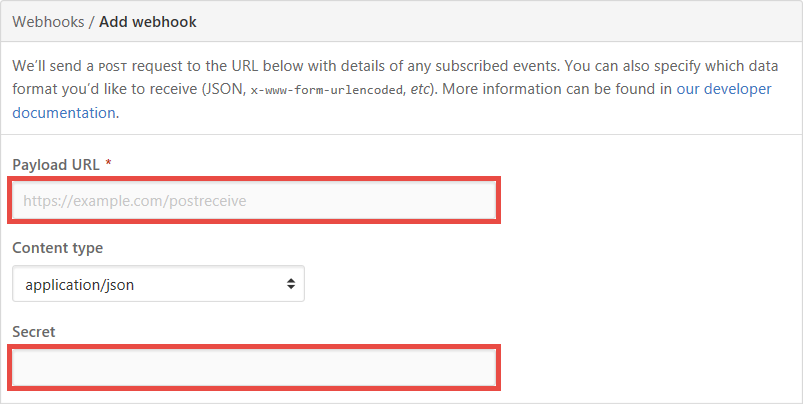
To respond to GitHub webhooks, offset create your function with an HTTP Trigger, and set up the webHookType property to github. And so re-create its URL and API central into the Add webhook folio of your GitHub repository.
Slack webhooks
The Slack webhook generates a token for yous instead of letting you specify information technology, so you lot must configure a function-specific key with the token from Slack. See Authorization keys.
Webhooks and keys
Webhook authorization is handled past the webhook receiver component, function of the HTTP trigger, and the mechanism varies based on the webhook type. Each machinery does rely on a central. By default, the role key named "default" is used. To utilise a different key, configure the webhook provider to transport the key name with the request in one of the following ways:
- Query string: The provider passes the key name in the
clientidquery string parameter, such ashttps://<APP_NAME>.azurewebsites.internet/api/<FUNCTION_NAME>?clientid=<KEY_NAME>. - Asking header: The provider passes the key name in the
x-functions-clientidheader.
Content types
Passing binary and form data to a non-C# office requires that yous use the appropriate content-type header. Supported content types include octet-stream for binary data and multipart types.
Known bug
In non-C# functions, requests sent with the content-blazon image/jpeg results in a string value passed to the function. In cases like these, you can manually catechumen the string value to a byte array to access the raw binary data.
Limits
The HTTP request length is express to 100 MB (104,857,600 bytes), and the URL length is express to iv KB (four,096 bytes). These limits are specified by the httpRuntime element of the runtime'due south Web.config file.
If a function that uses the HTTP trigger doesn't complete within 230 seconds, the Azure Load Balancer will time out and return an HTTP 502 fault. The function will go on running only will be unable to return an HTTP response. For long-running functions, we recommend that you lot follow async patterns and return a location where y'all tin ping the status of the asking. For information about how long a office can run, see Calibration and hosting - Consumption program.
Adjacent steps
- Return an HTTP response from a office
Feedback
Source: https://docs.microsoft.com/en-us/azure/azure-functions/functions-bindings-http-webhook-trigger
0 Response to "How to Read Data From Com Port and Separate by Function Key in Java"
Post a Comment